
The Preparedness Skill Nobody Practices: Improvisation

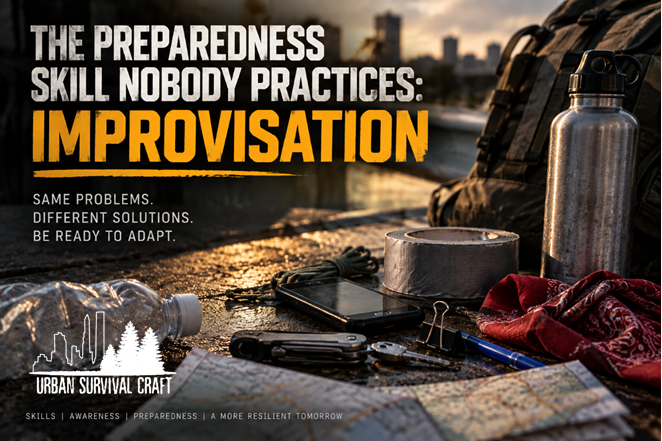
We prepare for emergencies by making plans, building kits and buying equipment.
Then reality happens.
The flashlight is in the other car. Your normal route is blocked. The battery you thought was charged isn't. The equipment you need is sitting safely at home.
Now what?
That's where one of the most overlooked preparedness skills comes in:
Improvisation.
The Tool Isn't the Skill
Having the right equipment makes life easier. But there's a difference between owning equipment and having capability.
A flashlight provides light—but the real need is illumination.
GPS provides directions—but the real need is navigation.
A water container carries water—but the real need is safe collection and storage.
When the usual tool isn't available, stop looking for a replacement for the tool and ask:
What am I actually trying to accomplish?
That question opens up possibilities.
Work With What You've Got
Improvisation doesn't mean inventing some complicated survival trick with duct tape and paracord.
It's basic problem-solving.
Look around and ask:
What do I have, and what can it do?
Think about ordinary objects by their properties rather than their intended purpose.
Something may be waterproof, reflective, absorbent, insulating, rigid, flexible, buoyant or strong.
A trash bag isn't only for trash.
A bandanna isn't only clothing.
A vehicle isn't only transportation.
A smartphone can still have useful functions even without cellular service.
The more you understand how ordinary things work, the easier it becomes to see other uses for them.
Knowledge Gives You Options
Skills make improvisation much easier.
If GPS fails but you understand direction, landmarks, street layouts and basic navigation, you still have options.
If your preferred method of treating water isn't available, understanding what different treatment methods actually accomplish helps you choose an alternative.
The same applies to first aid, communications, shelter and dozens of other preparedness skills.
Knowing why something works is often more useful than simply knowing which piece of equipment to reach for.
Try This
Here's a simple preparedness exercise.
The next time you check your emergency plan, remove one thing.
Your phone is dead. What now?
Your normal route home is blocked. What's your alternate?
Your emergency kit isn't accessible. What do you have around you?
Your primary flashlight doesn't work. How else can you produce safe light?
You're not trying to make things unnecessarily difficult.
You're looking for weaknesses.
If removing one item causes your entire plan to fall apart, you've found one.
Improvisation Has Limits
Being resourceful doesn't mean being reckless.
Electricity, fire, structural damage, contaminated water and serious medical emergencies aren't good places to experiment with something you don't understand.
Sometimes the best solution is to recognize that you don't have the equipment or knowledge to safely solve the problem.
Adaptability includes knowing when not to improvise.
Plan A Won't Always Be Available
Good preparedness gives us equipment.
Better preparedness gives us skills.
But eventually something won't go according to plan.
When that happens, take another look at what you have, decide what actually needs to be accomplished and start looking for another way to get there.
Because sometimes preparedness isn't about having the perfect tool.
It's knowing what to do when you don't.
Plans reducce Panic, Preparation creates options. Options create confidence.
— Urban Survival Craft


Comments